
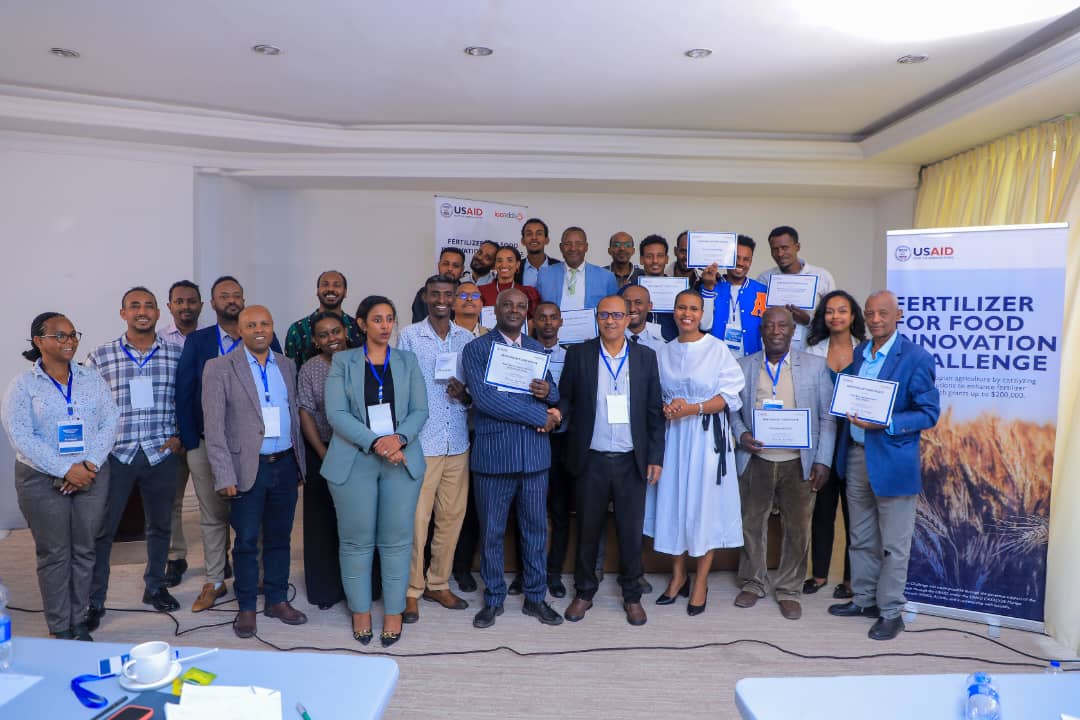
Open Innovation Challenge finalists announced
Six enterprises top of the Fertilizer for Food (F4F) Open Innovation Challenge (OIC)
Addis Ababa, Ethiopia - December 14th, 2023 – USAID CATALYZE MS4G Fertilizer for Food (F4F) Open Innovation Competition (OIC) Pitch Finalists: 6 finalist innovators emerge from an unforgettable Final Pitch Event! The atmosphere was incredible and the competition was fierce as Green.REE recycling, Ethio-garden Agro (PLC), Three A M Manufacturing Plc, Tedla Belachew Agricultural Input Supplier, Bogale Borena Organic Fertilizer Production Company, and THUR BIOTECH captivated the audience with their outstanding pitches. The event was a true testament to the power of innovation in agriculture.
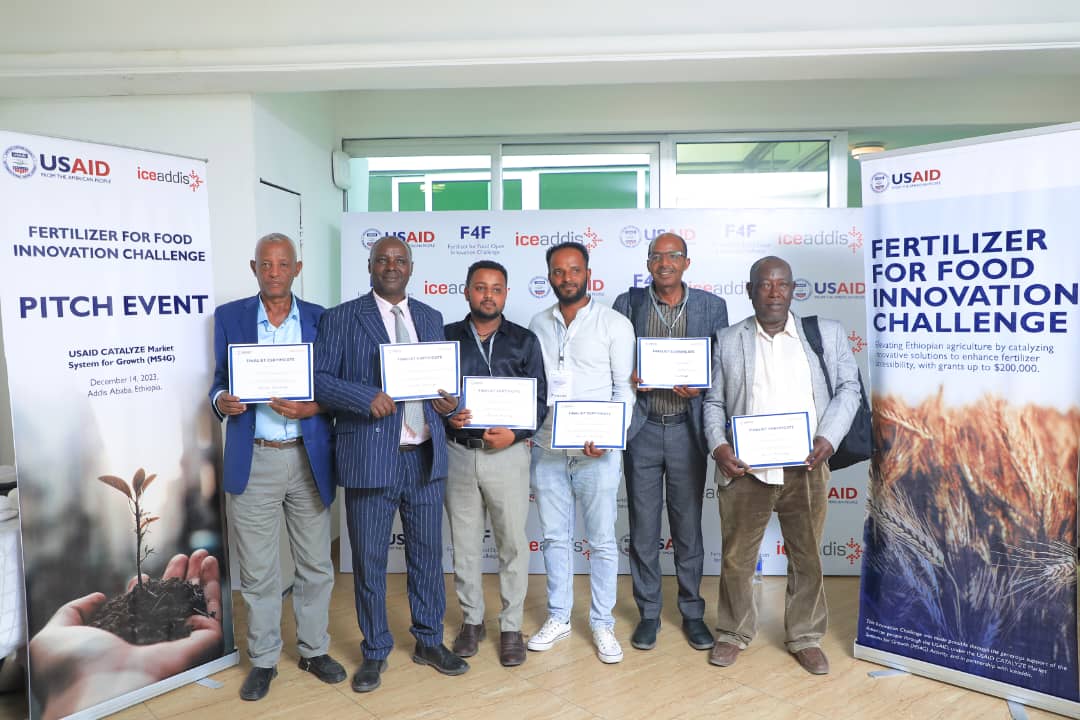
The list of finalists:
Green.REE recycling
Hawassa, Sidama region, Ethiopia
Our innovation is an organic fertilizer produced from solid waste such as food waste and crop residue to be used by farmers and small-scale urban agriculture enterprises engaged in vegetable and fruit production.
Composting is a largely biological process in which microorganisms (both aerobic and anaerobic) decompose organic matter and lower the carbon-nitrogen ratio of refuse resulting in a final product of well-rotted compost. The composting process decomposes organic matter by microorganisms under certain moisture, aerobic, or anaerobic conditions to produce a product in powder (the compost).
Bogale Borena Organic Fertilizer Production Company
Yirgalem, Sidama, Ethiopia
Our innovation is based on the production of Vermicompost. Currently, in our 5 Hectares of land we are using organic compost and distributing it to farmers in different areas of Dale Woreda in Sidama The company will solve the shortage of fertilize and price inflation on imported or non-organic Fertilizers.
Ethio-garden Agro (PLC)
Adama, Oromia, Ethiopia
The proposed liquid bio-fertilizer is distinctly environment-friendly, non-bulky, cost-effective, and easily available for plant nutrition. The technology has a low incorporation cost as it is a foliar application absorbed by the economic plants. The farmers need to spray the product every 15 to 20 days for three rounds. Our experience showed that 15 liters of foliar fertilizer/hectare will provide adequate nutrients to vegetables and cereal crops. The farmers can formulate 1 liter of the foliar product mixed with 20 liters of water. The project will purchase chicken manure from poultry farms and transport it to the processing plant located in Adama. Additionally, green plant leaves before the flowering stage, rejects of banana crushed bones will be mixed with water and covered for the primary level fermentation in the first tank.
The blended mix stays for 30 days, then the fermented interim product will be transferred to the second tank, and it will be mixed at a ratio of 1 to 4 proportion of water to extract the nutrients in liquid form. The liquid stays for additional 30 days for fermentation. The third step is the filtration of the final product after pumping it into the third tank. The last stage in the production process is bottling and labeling the product with containers of 1 liter, or 5 liters depending on the customers’ demand. The quality, PH (5-8), and nutrition content of the product have been tested and confirmed in the soil & plant nutrition laboratory.
Tedla Belachew Agricultural Input Supplier
Hawassa, Sidama region, Ethiopia
Our innovation is the production of organic fertilizer/compost using biodegradable waste materials such as food waste, crop residue, and other waste materials. Composting is a largely biological process in which microorganisms (both aerobic and anaerobic) decompose organic matter and lower the carbon-nitrogen ratio of refuse resulting in a final product of well-rotted compost. The composting process decomposes organic matter by microorganism under certain moisture, aerobic, or anaerobic conditions to produce a product in powder (i.e. the compost) which are stable, low in moisture, and free from pathogen.
The product from the composting process can be applied directly to soil as a bio-fertilizer that contains nutrients such as potassium, nitrate, sodium, calcium, magnesium, and chloride for plant growth. Compost has a high content of organic matter and important nutrients and is very useful for soil conservation and improving and maintaining soil fertility. However, one of the issues in the composting process is the long duration of time that is required to complete the process. For example, a small-scale organic matter com-posting using the windrow method took three to four months to produce compost.
Three A M Manufacturing Plc
Bishoftu, Oromia, Ethiopia
Our innovation is designed to alleviate these problems by producing and supplying organic liquid fertilizer that consists of micro and macro elements and effective microorganisms with consistent quantity and quality, and affordable price. Unlike chemical fertilizer, which contaminates the soil and water, this organic liquid fertilizer enhances the soil quality even more. It is a pure and effective biological process that focuses mainly on the production of a highly nutritious liquid fertilizer which is prepared based on the geologic conditions of an intended area.
Since there are various geological conditions throughout the country, we can produce effective liquid organic fertilizer for those different conditions specifically. This has come to fruition with the help of six kinds of effective microorganisms that we produce on our own.
Thur Biotech
Addis Ababa, Ethiopia
Thur Biotech specializes in advanced bacterial biofertilizers designed to enhance agricultural productivity and rejuvenate soil health. These biofertilizers are engineered to deliver outstanding results, boasting a 20-30% increase in crop yields. What is more, they are three times more cost-efficient than conventional chemical fertilizers and excel in acidic soil conditions, actively neutralizing acidity through continuous application over five years.
Our biofertilizers have undergone rigorous testing, with three years of research conducted in three regions. They not only fortify crops against diseases and drought but also reduce the need for pesticides, making agriculture more resilient to climate change. With an application rate of just 1.5 kilograms per hectare (compared to the 200-300 kilograms typically required by chemical fertilizers), our products significantly reduce costs and make sustainable farming accessible to smallholders and organic commercial farmers alike.